
The Hidden Cost of Remembering Everything
Some things are worth keeping. The work of keeping them doesn’t have to stay in your head until it actually needs you.

Recently, I read a short post by Seth Godin about replacing filters.
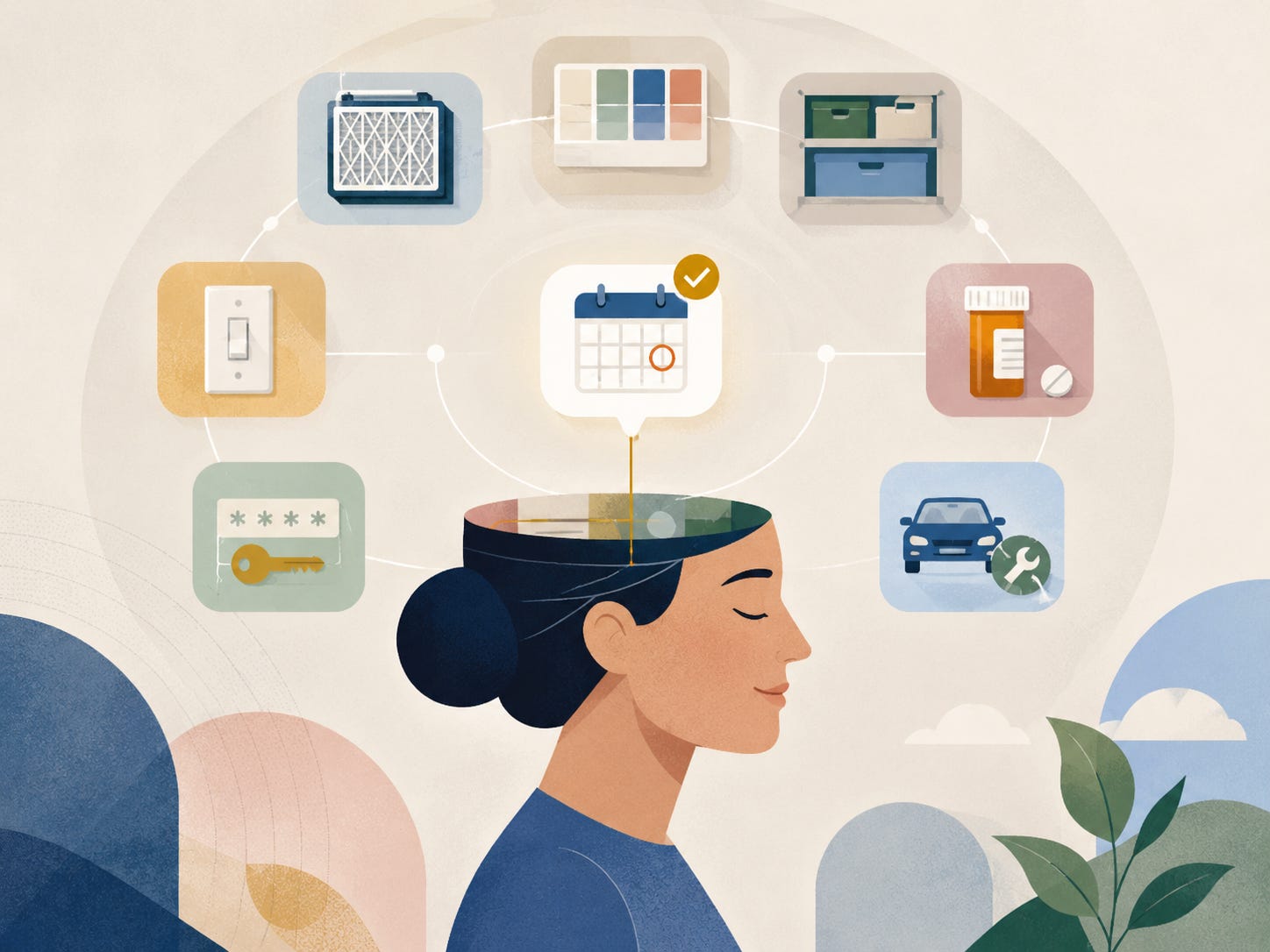
His suggestions were wonderfully ordinary. He recommends creating a recurring calendar event for anything with a filter that needs changing, including where the replacements are stored and where to buy more. He writes paint information on the back of a switchplate, and photographs reorganized drawers so he can find what is in them later.
Godin’s conclusion is that we should get better at writing down the things we are sure we will remember.
What interested me was one step beyond that.
The real value is not simply that the information has been recorded. It is that I no longer have to hold it in my head, and that it can come back when I actually need it.
The filter still has to be changed. The paint may eventually need touching up. Nothing has been eliminated.
What has changed is the amount of time the maintenance needs to occupy my attention.
The cost of remembering
I have been thinking about this because of what I have been calling the Maintenance Trap: when something we built to make life better starts using up the time, money, attention or freedom it was supposed to help create.
One response is to get rid of the thing. Sometimes that is exactly right.
But maintenance is not a binary choice between keeping something exactly as it is and eliminating it altogether. Sometimes the thing is still worth having. The problem is the way we are carrying it.
Homes, cars and our own bodies all require some degree of upkeep. Modern life also comes with renewals, warranties, insurance, passwords and the other small pieces of administration attached to things we may have perfectly good reasons to keep.
The work itself is only part of the cost.
There is also remembering the work.
I need to remember when something was last done, what I will need next time and where I put it. Nothing may require action today, but some part of the mind has still been assigned the job of not forgetting.
That is maintenance too.
In a shared household, there is another version of the same question: who is being asked to remember? Moving something out of one person’s head and quietly into another person’s is not much of an improvement.
A genuinely useful system can do something better. It can hold the responsibility until the responsibility actually requires us.
Let the system remember
There is a Daoist idea that helped me see this more clearly.
Wu wei is often translated as “nonaction,” although that can make it sound like passivity. The idea is more subtle than simply doing nothing. I read it as a way of acting without unnecessary forcing: the action still happens, but we do not need to surround it with constant intervention.
That seems surprisingly relevant to the small systems of ordinary life.
A good maintenance system does not mean never acting. It means not repeatedly thinking, checking or deciding when no action is required.
The filter reminder appears when the filter needs changing. The paint information waits behind the switchplate until someone needs it. The photograph of the drawer sits quietly until somebody is looking for what is inside.
The responsibility has not disappeared. It has simply stopped demanding continuous attention.
That may be one of the most useful roles technology can play in an increasingly complicated life.
What should technology remember so I don’t have to?
I do not want technology to run my life. I want it to hold information that does not deserve to remain mentally active, then return it when there is something useful for me to do.
The best systems do not constantly remind us that they exist.
They let us forget safely.
When the system becomes another thing to maintain
There is an obvious way to take this too far.
I could photograph every drawer, create recurring events for every appliance and build a database containing every warranty, medication and maintenance interval. Then I could spend Sunday afternoon checking whether my maintenance system was properly maintained.
I would have escaped one Maintenance Trap by constructing another.
That is why “be more organized” is not enough. Neither is “automate more.”
A better question is:
Does this reduce how often this thing needs my attention?
A reminder that appears twice a year with everything I need to change the filter probably passes. A dashboard I feel compelled to review every week to make sure I have not forgotten anything probably does not.
The distinction I care about is between quiet maintenance and attention-seeking maintenance.
Good maintenance stays quiet until something changes.
Keep the thing. Change how you carry it.
This gives me another option when something worth keeping starts asking too much of me.
I do not necessarily have to sell it, cancel it or hand it to somebody else.
If the task is predictable, I can schedule the trigger. If future me will need information, I can put it somewhere future me will naturally encounter it. If nothing can be done until a particular date or condition changes, I can let the issue disappear until then.
Letting a responsibility go quiet is not the same as ignoring it. It is deciding when it deserves attention.
The best note may not be the one I carefully file somewhere. It may be the one I do not have to remember exists.
I do not need everything I value to become maintenance-free.
I want the maintenance to appear when it actually needs me — and, until then, to stay quiet.