
I Can Afford It. But Do I Want to Carry It?
Affordability tells you whether you can buy something. It says much less about the time, attention, uncertainty and responsibility it will keep asking from you.

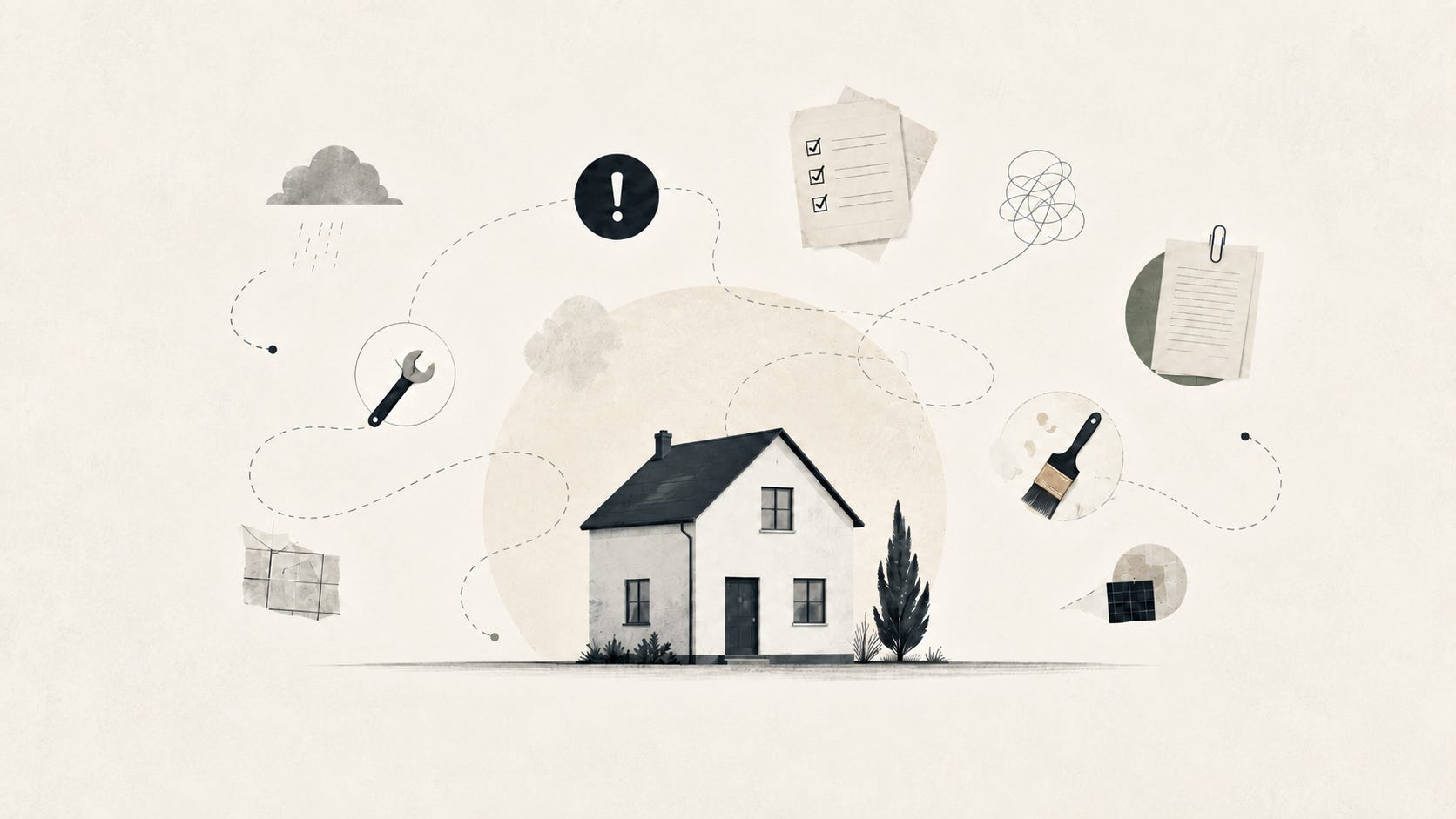
Earlier this year, I reached an important milestone in a project at work.
It had taken a long time. It was complicated, involved many people, and represented the kind of work that does not come around very often. We had reached the point where we could finally share the result with the people who mattered. By any reasonable measure, it was a success, and I had every reason to feel proud of what we had done.
I did feel proud.
What surprised me was how quickly the feeling disappeared.
Almost as soon as the milestone was complete, my mind moved to everything else that was still open. There were family matters. Health concerns. Other responsibilities. And somewhere among them was another message about one of my rental properties.
That particular property had already had quite a year.
First there was a raccoon problem. Then a wasp nest. Then trees that needed attention. Then mold.
None of these was financially catastrophic. I had a property manager. There were contractors who could deal with the work. The property generated income, and the bills could be paid.
But every problem still came back to me in the form of a decision.
What should we do? Which option? How far should we go? Is this urgent? Is that quote reasonable? What happens if we leave it? What risk am I taking if I choose the cheaper option?
The property manager was managing the property.
I was still managing the decisions.
And that was when something about the imbalance became difficult to ignore. I had just completed something genuinely significant, something I had worked toward for a long time, yet in my mind it had almost immediately become one completed item among dozens of incomplete ones.
A major achievement and a raccoon had somehow ended up competing for space on the same mental to-do list.
The problem was not that I had too much work to do.
The problem was that too many things were still open.
For most of my adult life, I have been fairly disciplined about not buying things simply because I could afford them.
A larger house is the obvious example. I knew I could spend more on a home, but I never particularly wanted to be house rich and life poor. I did not want too much of my wealth locked into one place simply because a bank was prepared to lend me the money.
So I invested instead.
Over time, I bought rental properties. I wanted income, diversification and another source of financial security beyond the stock market. Even within real estate, I tried to diversify. Student housing was different from retail. Retail was different from industrial property. Different assets carried different risks.
I did the same thing elsewhere. I bought insurance. I planned for things that might go wrong. I tried not to leave myself dependent on one outcome.
This is partly how my mind works. I tend to think several moves ahead. I notice uncertainty, concentration and downside risk. If I can build a system that leaves me in a stronger position when something unexpected happens, I usually will.
For a long time, that instinct served me well.
The investments produced income. The properties appreciated. My overall financial position became stronger and more diversified. I had more security than before and more choices about what I could do next.
The strategy worked.
That turns out to be important, because I do not think what I am feeling now is regret.
I am not trying to prove that I should never have bought the properties. I think they were good decisions for the person I was and the problem I was trying to solve.
What I am beginning to question is whether a good decision has to remain a permanent one.
Sometimes the thing you built does exactly what you wanted it to do.
Then you keep carrying it anyway.
The financial cost of owning a rental property is relatively easy to see.
Taxes. Insurance. Repairs. Financing. Management fees. Legal fees. Vacancies. Maintenance.
They all show up somewhere.
Attention does not.
The raccoon itself did not consume much of my life. Neither did the wasp nest or the trees or the mold, considered separately. Other people did much of the actual work.
But each problem created another open loop.
There would be a message. I would read it. I might need more information. Someone would come back with options. I would think through the risks. Perhaps I would make a decision immediately; perhaps I would wait. Either way, some small part of the issue remained in my head until I knew it was resolved.
That is the cost I had underestimated.
There is a kind of background processing that never appears on a calendar.
You can be reading a book and remember that you still have to answer someone.
You can be watching something on Netflix and wonder whether you should check an email.
You can be away and see a WhatsApp message from a property manager, an agent or someone else you have hired to make your life easier, and feel your attention move instantly from where you are to a problem somewhere else.
The interruption may last only a few minutes.
The mental ownership can last much longer.
For someone like me, uncertainty has a particular pull. If I know there is something I could do to put myself in a better position, part of my mind wants to work out what that thing is.
Sometimes that is useful. It is one reason I plan and manage risk well.
But there is a difference between uncertainty that life gives you and uncertainty you continue choosing to own.
There are things I cannot make certain. My health. The health of people I care about. Family circumstances. Relationships. What will happen at work. What the future will look like.
Those are part of being alive.
But a raccoon in an investment property is optional uncertainty.
So is the mold.
So is the next lease decision, contractor quote or repair question that exists only because I continue to own the asset that generates it.
I am beginning to think there is uncertainty we have to learn to live with, and uncertainty we no longer need to keep buying.
The standard answer to all of this is delegation.
Hire a property manager. Use an agent. Call a lawyer. Get a contractor.
I do all of those things, and they help enormously.
But I have learned that delegating the work is not the same as eliminating the responsibility.
The contractor can tell me what needs to be done. The property manager can get quotes. The lawyer can explain the risks. Someone else can make the phone calls, visit the property and coordinate the work.
Eventually, though, the question comes back.
What do you want to do?
The more I delegate, the less labour I perform myself. But I still own the decision and its consequences.
There is also a strange economic problem hidden inside that arrangement. If an investment increasingly requires me to pay other people so that I do not have to spend my own time and attention on it, those costs reduce the return that made the investment attractive in the first place.
At some point, that raises a very simple question.
If I have to pay increasingly more to avoid spending my life on an investment, how much do I actually want the investment?
For years, I thought carefully about return on capital.
I am now much more interested in return on attention.
That calculation has changed because my life has changed.
When I had less money and less security, another good investment mattered a great deal. Spending some time dealing with complexity was a reasonable price for strengthening my financial position.
I was exchanging capacity in the present for greater security in the future.
Today, the marginal value of that trade is different.
I have more financial security than I had when I began. The investments have already done much of what I wanted them to do. Another increment of return still matters, but not in the same way it once did.
Meanwhile, the things on the other side of the trade have become more valuable to me.
Not in the abstract sense of wanting “more family time” or “more experiences.” I mean something much more ordinary.
I want to be able to read a book and just read the book.
I want to watch a television series without part of my mind asking whether there is something more responsible I should be doing.
I want to go somewhere and remain where I am, rather than being pulled back by a message about a problem I delegated but still own.
I want to finish something important and actually feel that I finished it.
That is what I mean when I say I want a simpler life.
Not an emptier one. Not a life without work, responsibility or difficulty.
I want less unnecessary competition for my attention.
This thinking has already changed something.
I have started the process of selling some of the real estate.
The interesting part is that the properties have not all disappeared from my life yet. Selling takes work too. There are decisions, documents, agents, timing and practical issues to manage. Where tenants are involved, an investment I may choose to exit is also somebody else’s home, so simplifying my side of the equation does not remove my responsibility to handle the transition properly.
In the short term, putting something down can require more attention than continuing to carry it.
And yet I noticed something almost immediately after deciding to move in that direction.
I felt lighter.
The problems had not all been resolved. The work was not finished. But something important had changed: I could see an end.
Before, every repair or decision was part of an indefinite future of more repairs and more decisions. Now those same tasks belong to a process that is going somewhere.
There is an end of the tunnel.
That difference matters more psychologically than I expected.
When your mind is already full, even the task that would make it less full can feel like one task too many. It is easy to postpone simplification until life calms down.
But sometimes life will not calm down until you do the simplifying.
This has made me reconsider what I mean when I say that I can afford something.
Affordability is mostly a financial test.
Can I pay for it?
Can I absorb the downside?
Can I maintain it without putting myself in danger?
Those are important questions, but they are incomplete.
I can afford the property.
I can afford the repair.
I can afford the property manager.
I can afford the lawyer.
What I am less willing to spend now is the part of my mind that comes attached to all of them.
And once I saw that distinction in real estate, I started seeing it elsewhere.
A larger house can be financially affordable and still require more of your life than you want to give it.
A more senior role can pay more and still be a bad exchange for the attention it consumes.
A business, a second home, a board position, a complicated investment structure or almost any other opportunity can look attractive if the only question is whether you have the resources to take it on.
But everything we acquire makes some future claim on us.
The question is whether the claim is still worth paying.
Some absolutely are.
The people I love make claims on my life. Meaningful work does. Health does. Commitments I have chosen and still believe in do.
I do not want to remove those claims. I want enough capacity left to carry them well.
Which means I have become more interested in removing the ones that no longer have a good reason to be there.
I used to think diversification gave me more freedom.
It did.
But options have to be maintained too.
That is the part I had not thought about enough.
Every additional asset, system and commitment may increase what I can choose from while also increasing what I have to keep running in order to preserve those choices.
At some point, more optionality can begin consuming the capacity required to use it.
I think I have reached that point with at least some of what I own.
The answer is not to decide that the original strategy was wrong.
It is almost the opposite.
The properties helped create the security from which I can now ask whether I still need them.
They did their job.
Perhaps that is one of the privileges of eventually having enough: you can stop demanding that every successful decision continue proving itself forever.
You can look at something that made your life better and still decide that its work is finished.
So I still ask whether I can afford something.
But now I ask another question too.
Do I want to carry it?
Not only the purchase price.
The decisions. The uncertainty. The monitoring. The responsibility. The part of my attention that will remain attached to it after the money has changed hands.
And if I no longer want to carry it, there is one more question that matters.
What will I do with the capacity I get back?
Right now, my answer is surprisingly simple.
Sometimes I would just like to finish something, sit down, and be where I am.
The building was not a mistake.
It worked.
Now I want to use some of what it built.